A settlement agreement cannot lawfully waive every type of employment claim. Certain statutory rights — including accrued pension rights, latent personal injury claims, some family-related pay, and data subject access rights — may fall outside what any settlement agreement can validly settle, however the waiver is worded. Below we set out the main claims that are excluded, restricted, or legally uncertain, so you know exactly what you are, and are not, giving up when you sign.
Accrued pension rights
It is not possible to waive accrued pension rights under a settlement agreement. This protection comes from section 91 of the Pensions Act 1995, which prevents an individual from surrendering, commuting or assigning rights that have already built up in an occupational pension scheme. Whatever wording an employer’s settlement agreement uses, any accrued pension entitlement you already hold survives the agreement and cannot be signed away.
Latent and future personal injury claims
It would usually be unreasonable to settle freestanding personal injury claims that the employee is not aware of, or could not reasonably be aware of, and these are routinely excluded from the terms of a settlement agreement. A typical example is exposure to asbestos that leads to illness, or work-related hearing loss, where the harm is hidden at the time of signing and only comes to light later. If the agreement is seeking to waive latent freestanding personal injury claims, an amendment can be sought to change that.
Personal injuries that have not yet occurred at the point of signing cannot be settled at all. Any clause purporting to settle injuries that happen in the future would likely be unenforceable, applying the Unfair Contract Terms Act 1977 and/or section 1(3) of the Law Reform (Personal Injuries) Act 1948.
Personal injury claims under Equality Act 2010 may be waived in a settlement agreement (i.e., the right to bring discrimination and harassment claims).
Statutory family-related pay
A settlement agreement cannot be used to settle claims for the following types of statutory family pay:
- Statutory maternity pay
- Statutory paternity pay
- Statutory adoption pay
- Statutory shared parental pay
- Statutory parental bereavement pay
- Statutory neonatal care pay
Collective redundancy consultation claims
Where an employer proposes 20 or more redundancies at one establishment within a 90-day period, it must inform and consult appropriate representatives under section 188 of the Trade Union and Labour Relations (Consolidation) Act 1992 (TULRCA). A settlement agreement can compromise a claim for failure to pay a protective award under section 192 of TULRCA, and a claim for failure to comply with the obligations concerning the election of employee representatives.
TUPE claims
Claims for failure to inform and consult under the Transfer of Undertakings (Protection of Employment) Regulations 2006 (TUPE), or for the compensation payable where that duty is breached, sit outside what an individual settlement agreement can effectively waive. A claim for failure to provide employee liability information also cannot be validly waived by a statutory settlement agreement.
Data protection rights
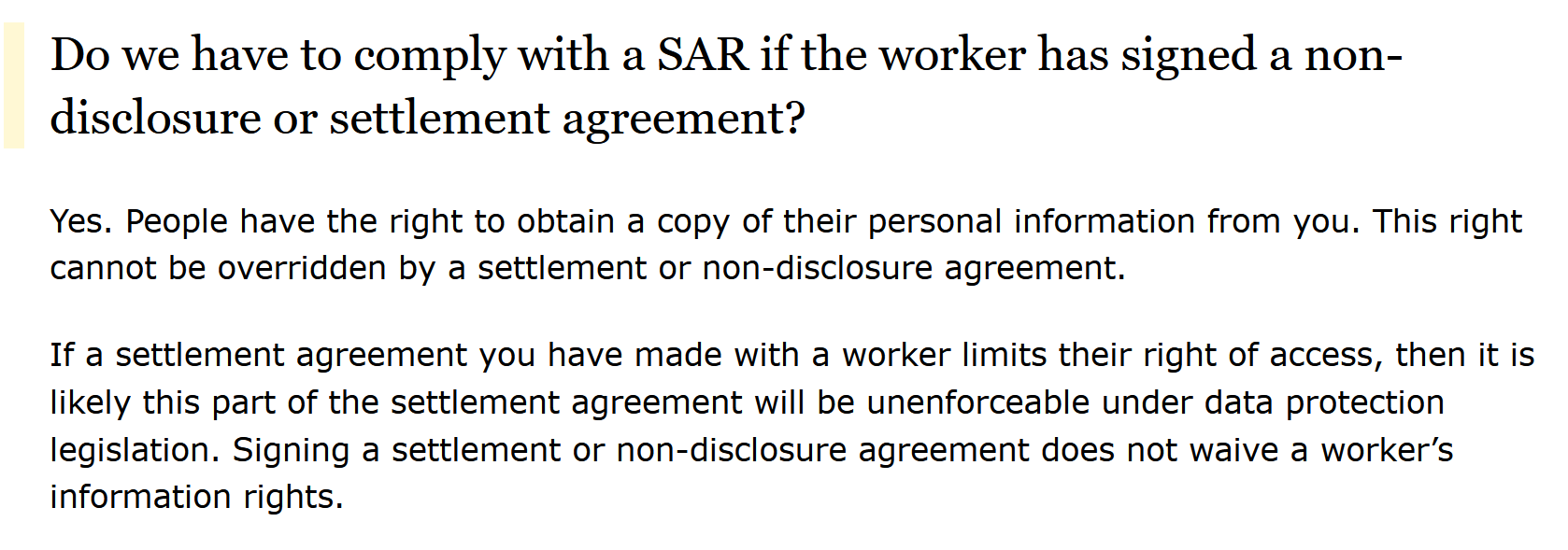
It is strongly arguable that an employee cannot waive their rights under the UK GDPR and the Data Protection Act 2018 (DPA), including subject access rights such as the right to access their own personal data. This is supported by the UK’s data protection regulator, the Information Commissioner’s Office (ICO), which has confirmed that “signing a settlement or non-disclosure agreement does not waive a worker’s information rights.” If a settlement agreement, or the confidentiality provisions within it, purport to limit a worker’s right of access, that part of the agreement is likely to be unenforceable. A civil claim for damages arising from a data protection breach, by contrast, is capable of being validly settled.
ICO website extract:
Agency worker and zero hours contract claims
Certain claims under the Agency Workers Regulations 2010 (SI 2010/93) cannot be settled by a statutory settlement agreement.
Some detriment claims under the Exclusivity Terms in Zero Hours Contracts (Redress) Regulations 2015, and certain claims under the blacklisting regulations, fall outside what a standard settlement agreement can validly compromise.
Can future claims be settled?
Whether a settlement agreement can waive future claims — claims relating to events that have not yet happened — has been legally uncertain in the past. In 2022, the Employment Appeal Tribunal held in Bathgate v Technip UK Ltd that unknown future claims could not be validly waived. However, that decision was overturned on appeal in Bathgate v Technip Singapore Pte Ltd [2023] CSIH 48; [2024] IRLR 326, where the Court of Session held that future claims can be compromised, including claims that did not exist at the time of the settlement, provided the wording used is plain and unequivocal about what is being given up.
That approach was confirmed for England and Wales in Clifford v IBM United Kingdom Ltd [2024] EAT 90, where the EAT applied the Court of Session’s reasoning and held that a compromise agreement can validly waive future claims, provided the claims being given up are clearly identified rather than covered by a general, catch-all waiver.
The position is therefore now more settled than it was, but it remains fact-sensitive, and may be open to challenge on appeal in the future. You should speak to your solicitor about how your settlement agreement is drafted in relation to future claims, particularly where you will remain employed after signing, or where you are concerned that your employer, or its people, might take action against you after termination that gives rise to a new legal claim, such as post-termination victimisation.
| The bottom line A settlement agreement is a powerful tool for drawing a line under employment and settling claims an employee has or may have, but it is not unlimited in its powers to settle employment claims. Pension rights already accrued, future personal injury claims, certain statutory rights to family pay, some collective redundancy and TUPE rights, and arguably core data protection rights cannot be waived under a statutory settlement agreement. In these cases some employers may elect to hold back settlement monies or pay by instalments |
| Not sure what your settlement agreement is asking you to give up? Get your settlement agreement reviewed by a specialist settlement agreement solicitor, at a fixed fee capped at your employer’s contribution. See our cost promise |
Legal Disclaimer
The contents of this article are intended to be for general information purposes only and do not amount to (nor are they intended to be) legal, tax or financial advice or a complete or authoritative statement of the law nor should they be treated as such. No warranty or promise is given, express or implied, as to accuracy of the information on this page and no liability is accepted for any error or omission. You should instruct a specialist employment solicitor to advise you on your particular situation and not act or rely on the information on this page.